Support our educational content for free when you purchase through links on our site. Learn more
📦 Pack Non-Essentials 7 Weeks Before a Move: 12 Steps

If you’re asking, “How do I start packing non-essential items 7 weeks before a move?”, begin with belongings you won’t need before moving day—seasonal décor, off-season clothing, spare linens, books, and rarely used hobby gear. Declutter first, pack one small category at a time, and label each box with its destination room, contents, and priority.
Seven weeks out is a head start, not a cue to pack your coffee maker and regret it tomorrow morning. We’ve seen a neatly labeled box become an unexpected scavenger hunt because its owner packed something they still used daily; a simple “keep accessible” list would have saved the search.
Start with a closet, guest room, or storage shelf, then track each box in a moving checklist. Keep medication, documents, work essentials, and daily-use items out of the packing zone—and confirm any mover restrictions before boxing unusual or hazardous belongings.
Key Takeaways
- Pack what you can comfortably live without until moving day: seasonal items, extra linens, books, décor, and unused hobby supplies.
- Declutter before boxing. Sort items into keep, donate, sell, and recycle or dispose.
- Work in small sessions by room, shelf, or category to make steady progress without disrupting daily life.
- Label and inventory every box with its destination, contents, and priority.
- Keep essentials accessible, including medication, important documents, chargers, and everyday clothing.
- Use a flexible timeline. Your home size, move distance, schedule, and mover’s services all affect how early to pack.
Table of Contents
- ⚡️ Quick Tips and Facts: Packing Non-Essentials 7 Weeks Before a Move
- 📦 Why Seven Weeks Is a Smart Time to Start Packing
- 🗓️ Your Seven-Week Moving and Packing Timeline
- What to Pack at Seven Weeks Out
- What to Leave Until Moving Week
- 🏠 What Counts as a Non-Essential Item?
- Non-Essential Items You Can Pack Early
- Items to Keep Accessible for Daily Life
- 🧹 Declutter Before You Pack: Keep, Donate, Sell, or Recycle
- ✅ 12 Steps to Start Packing Non-Essentials Seven Weeks Before Moving
- 1. Gather Moving Supplies and Set Up a Packing Station
- 2. Make a Room-by-Room Packing Plan
- 3. Start with Storage Areas and Rarely Used Rooms
- 4. Pack Seasonal Clothing and Extra Linens
- 5. Box Books, Collectibles, and Display Items
- 6. Pack Extra Kitchenware and Special-Occasion Items
- 7. Protect Artwork, Mirrors, and Fragile Decor
- 8. Organize Hobby Gear, Games, and Craft Supplies
- 9. Label Every Box Clearly
- 10. Create a Moving Inventory
- 11. Set Aside Donations and Items to Sell
- 12. Schedule Small, Consistent Packing Sessions
- 🏷️ How to Label, Inventory, and Track Packed Boxes
- 🧻 Packing Materials: What to Use and What to Skip
- ⚠️ Packing Mistakes to Avoid Seven Weeks Before a Move
- 🧤 Special Considerations for Fragile, Valuable, and Sentimental Items
- 🚚 Adjusting Your Packing Plan for Local and Long-Distance Moves
- 📅 How to Stay on Schedule as Moving Day Gets Closer
- 🔗 Recommended Moving and Packing Resources
- ❓ Frequently Asked Questions About Packing Early
- 📚 Reference Links
- 🎉 Conclusion
⚡️ Quick Tips and Facts: Packing Non-Essentials 7 Weeks Before a Move
If you’re wondering what to do 7 weeks before moving, start by choosing items you can comfortably live without until moving day: seasonal décor, out-of-season clothes, rarely used books, collectibles, and hobby gear. Seven weeks is a useful head start, not a rule that every household must follow.
Movers’ timelines vary. College HUNKS Hauling Junk recommends starting non-essential packing around six weeks out: “Start packing non-essential items (decor, off-season clothes, books).” Sterling Van Lines also places this step at six weeks. Starting at seven weeks simply gives you more time to declutter and pack in short sessions—especially if you have a large home, a long-distance move, or a full calendar.
| Quick decision | A good default |
|---|---|
| Pack first | Storage-area items, seasonal décor, spare linens, books you won’t reread |
| Keep handy | Daily clothes, medications, work gear, essential cookware, chargers |
| Pack in sessions | One shelf, drawer, or small category at a time |
| Label boxes | Room + contents + priority + “FRAGILE” when needed |
| Track progress | Use a written inventory or a moving checklist app |
| Before sealing a box | Check that everyone in the household can manage without what’s inside |
Our rule of thumb: if you haven’t used it in the last month and won’t need it before moving day, it may be a good early-packing candidate. Exceptions include seasonal or specialty items you’ll need because of weather, work, school, or health.
For more planning advice, browse our DIY moving tips and home organization guides. You’ll soon see why “non-essential” is less about the object and more about when you’ll need it.
📦 Why Seven Weeks Is a Smart Time to Start Packing
Seven weeks out is a comfortable point to start small, low-risk packing jobs. You’re early enough to sort, donate, and find suitable packing materials without turning your living room into a cardboard maze. But you’re close enough that the move date feels real.
That said, timelines differ for good reasons. A one-bedroom local move may need less advance packing than a family move across the country. A professional packing service may also change how much you need to pack yourself. Sterling’s timeline begins the preparation process earlier, while College HUNKS places packing non-essentials at six weeks. Trust the logic behind a timeline, not the calendar number alone: prepare first, pack what you can spare, and leave daily necessities accessible.
| Starting earlier can help you… | But don’t… |
|---|---|
| Spread packing over manageable sessions | Pack things you’ll need next week |
| Identify what to donate or sell | Keep unwanted items in boxes “just in case” |
| Discover supply needs before the rush | Buy supplies before estimating what you’ll actually pack |
| Build a clearer inventory | Treat an early-packed box as a reason to stop reviewing its contents |
| Spot fragile or unusual items that need extra care | Assume every mover transports every item |
Moving can be a chance to reset—not just transfer every object you own from one address to another. The Federal Trade Commission’s moving guidance recommends researching movers and understanding your rights and responsibilities. Our practical addition: declutter before you box, so you’re not paying effort, space, and attention to move things you no longer want.
We once helped a household whose “spare room” had quietly become a museum of old lamps, craft supplies, and travel souvenirs. They started seven weeks out, but the real win wasn’t the early packing. It was deciding what deserved a place in the next home. So where should you begin? The answer is usually not the kitchen.
🗓️ Your Seven-Week Moving and Packing Timeline
Use this timeline as a flexible guide, not a packing law. The right pace depends on your home size, schedule, move distance, and whether you’re hiring movers or packing yourself. For a broader schedule, see our moving checklist and long-distance moving advice.
| Time before moving day | Packing focus | Planning check |
|---|---|---|
| 7 weeks | Declutter and pack clearly non-essential items | Confirm move date and start an inventory |
| 6 weeks | Continue seasonal and seldom-used items | Gather supplies and compare mover services |
| 5 weeks | Pack more décor, books, collections, and spare household goods | Review what you’re keeping, donating, or selling |
| 4 weeks | Pack room by room, leaving daily-use items out | Measure large furniture and check access routes |
| 3 weeks | Reduce duplicate kitchenware, linens, and hobby supplies | Arrange donation pickups or sales |
| 2 weeks | Pack most remaining non-essentials | Prepare an essentials box and confirm logistics |
| Final week | Pack daily-use items last and keep necessities accessible | Keep documents, medication, and valuables with you |
This is a progression, not a demand to fill a certain number of boxes each week. If you’re busy, pack one shelf per evening. If your home is full of collections, you may need to start earlier. If you’re using full-service packing, ask the company which tasks it handles and what you should set aside.
What to Pack at Seven Weeks Out
Start with belongings you can confidently leave boxed until after the move:
- Seasonal décor you won’t use before moving day, such as holiday decorations outside their season.
- Off-season clothing and shoes, provided the weather forecast and your plans make them unnecessary.
- Books and media you don’t plan to read, watch, or use before the move.
- Guest-room extras, spare blankets, decorative pillows, and extra towels.
- Collectibles and display pieces that aren’t needed for daily comfort.
- Hobby supplies for activities you’re pausing during the move.
- Extra kitchenware, such as specialty serving dishes or duplicate gadgets.
- Wall art and decorative objects, once you’ve decided what’s making the trip.
Pack one category at a time. It’s easier to find your winter scarves when the box is labeled “Hall closet: winter accessories” than when it says “stuff.” The National Institute of Standards and Technology’s SI guidance won’t help you label a box, but a clear, consistent system will: use the same room names throughout your inventory and on every carton.
What to Leave Until Moving Week
Keep anything you rely on before, during, or immediately after the move out of long-term storage. That often includes:
- Daily clothing, shoes, uniforms, and outerwear for the current season.
- Prescription medication, first-aid supplies, glasses, and mobility aids.
- Work, school, and childcare essentials.
- Regular cookware, dishes, coffee equipment, and water bottles.
- Phone chargers, laptops, internet equipment, and important documents.
- Cleaning supplies you’ll need to leave your current home in suitable condition.
- Pet food, leashes, carriers, and other daily animal-care supplies.
- Bedding and towels needed until the last night in your home.
Don’t pack a necessity just because it fits neatly in a box. We once watched someone seal up the kettle six weeks early. The box was beautifully labeled; the morning coffee situation was not. Keep a “still using” zone, and move items from it into boxes only when their last-use date is clear.
🏠 What Counts as a Non-Essential Item?
A non-essential item is something you can live without until moving day, not necessarily something unimportant. That distinction matters. A keepsake may be emotionally essential even if you don’t use it every day, while a kitchen tool you rarely notice may become essential if it’s the only way you prepare a particular meal.
Try this quick test:
- Will I use it before the move?
- Would not having it cause a health, work, school, care, or safety problem?
- Can I pack it without disrupting someone else in the household?
- Do I want to move it at all?
If the answer to the first three questions is no and the fourth is yes, it’s probably a good packing candidate. If you don’t want it, don’t pack it—sort it for donation, resale, recycling, or disposal. Our decluttering advice can help you make those decisions without holding a family summit over every coffee mug.
Non-Essential Items You Can Pack Early
| Category | Examples | Packing note |
|---|---|---|
| Seasonal items | Holiday decorations, off-season clothing | Keep weather-appropriate items accessible |
| Books and media | Extra books, DVDs, records | Use smaller boxes for heavy contents |
| Décor | Vases, framed art, ornaments | Wrap fragile pieces individually |
| Guest-room items | Spare bedding, decorative cushions | Leave one set accessible if guests are expected |
| Collections | Figurines, souvenirs, display items | Photograph arrangements before disassembly |
| Hobby gear | Specialty tools, rarely used craft supplies | Keep active projects separate |
| Kitchen extras | Serving dishes, duplicate utensils | Keep your everyday cooking setup intact |
| Storage items | Labeled keepsakes, archived paperwork | Keep vital records with you, not on the truck |
Items to Keep Accessible for Daily Life
Keep essentials in a clearly marked area, separate from packed cartons. A small “do not pack yet” list can prevent a frustrating search through 20 nearly identical boxes.
- Health and safety: medication, medical devices, eyewear, first-aid basics.
- Important records: identification, lease or closing documents, insurance details, moving paperwork.
- Daily routines: chargers, toiletries, work tools, school supplies, pet essentials.
- Home operations: keys, basic cleaning products, a few dishes, a towel, and bedding.
- Personal valuables: jewelry, cash, passports, and ireplaceable small items.
The U.S. Department of Transportation’s FMCSA moving resources offer advice for researching interstate movers. Regardless of who’s carrying the boxes, keep important documents and valuables under your own control whenever practical.
🧹 Declutter Before You Pack: Keep, Donate, Sell, or Recycle
Packing a thing you don’t want is just decluttering with extra steps. Before sealing a box, sort items into four groups:
| Decision | Use it for | Next action |
|---|---|---|
| Keep | Items you want and expect to use | Pack, or keep accessible if needed |
| Donate | Usable items someone else could use | Check the organization’s accepted items and drop-off rules |
| Sell | Items with resale value and enough time for a sale | Photograph and list promptly; set a decision deadline |
| Recycle or dispose | Items that are broken, unsafe, or not accepted for donation | Follow local waste and recycling guidance |
For donation options, check Goodwill’s donation guidance or your local charity’s current acceptance rules. For household hazardous waste, batteries, paint, or electronics, consult your local waste authority; the U.S. Environmental Protection Agency explains recycling considerations and links to relevant guidance.
Be realistic about selling. A table listed online for six weeks can become another move-day problem if no one buys it. Set a deadline: if it hasn’t sold by a chosen date, decide whether to donate, recycle, or move it.
We recommend a “maybe” box only for genuine uncertainty—and with a review date written on it. Otherwise, “maybe” can become a secret fourth room.
✅ 12 Steps to Start Packing Non-Essentials Seven Weeks Before Moving
Seven weeks gives you breathing room, so use it to make thoughtful progress rather than speed-run your entire house. Here’s the method our crew uses to keep early packing practical and reversible.
1. Gather Moving Supplies and Set Up a Packing Station
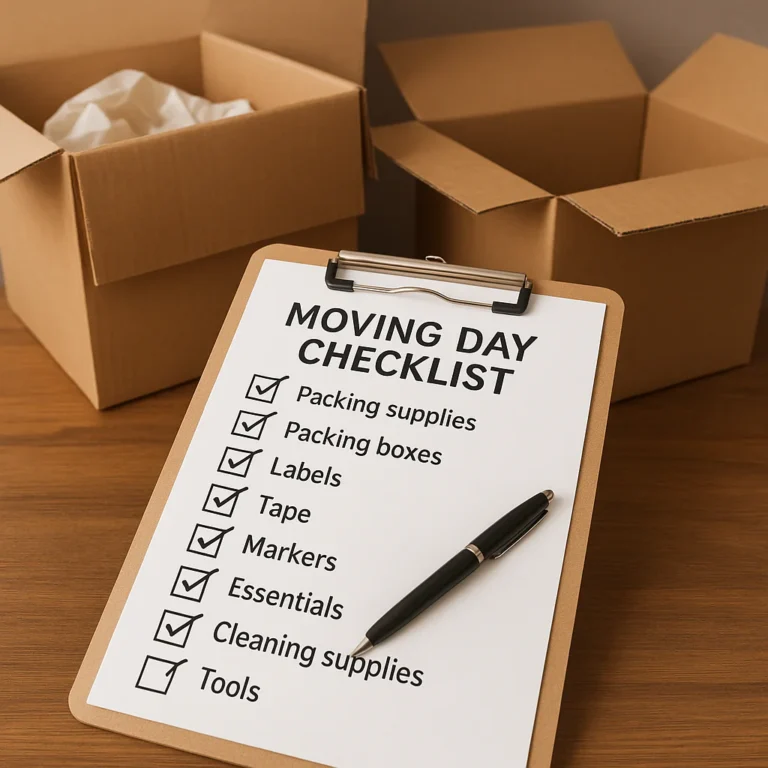
Choose a dry, low-traffic spot for tape, markers, labels, packing paper, and boxes. You don’t need a mountain of materials on day one. Start with what matches your first packing categories, then restock based on the actual volume.
Useful basics include:
- Sturdy boxes in a few manageable sizes.
- Packing tape and a dispenser.
- Permanent markers or printed labels.
- Packing paper or clean cushioning materials.
- Scissors, a tape measure, and a box cutter stored safely.
- Specialty protection for fragile or unusually shaped belongings, if needed.
Use towels, linens, or clean clothing as cushioning where appropriate, but don’t wrap dusty or damp items in them. For general packing guidance, the American Moving & Storage Association archive at the U.S. DOT and your chosen mover’s instructions are more useful than assuming every fragile item needs the same treatment.
2. Make a Room-by-Room Packing Plan
List rooms and the categories within them. Then mark each category pack now, pack later, keep out, or remove from the home. A checklist app can make the plan easier to update when the moving date or household needs change.
Example:
| Room | Pack now | Keep accessible | Donate or sell |
|---|---|---|---|
| Bedroom | Off-season clothes, spare blankets | Current wardrobe, medication | Unworn clothes |
| Living room | Extra décor, books | Remotes, chargers | Duplicate décor |
| Kitchen | Special-occasion dishes | Everyday cookware | Unused gadgets |
| Garage | Archived hobby gear | Basic tools | Broken or unwanted equipment |
Keep the plan visible, and give each person a manageable assignment. “Pack the house” is not an assignment; “box the board games on the lower shelf” is.
3. Start with Storage Areas and Rarely Used Rooms
Begin with closets, guest rooms, storage shelves, and hobby areas—not the kitchen you use every day. These zones often contain forgotten items and offer quick wins. Work in small sections so you can stop without leaving a room unusable.
Before packing stored items, check for moisture, pests, or damage. Don’t box anything damp, dirty, or unsafe. If you find chemicals or other hazardous materials, ask your mover and local waste authority how to handle them; movers may restrict certain items.
4. Pack Seasonal Clothing and Extra Linens
Pack clothes that are genuinely out of season and unlikely to be needed before moving day. Use clean boxes or suitcases, and make labels specific: “Main bedroom: winter coats” beats “clothes.”
Vacuum storage bags can reduce bulk for suitable soft items, but they’re not a universal solution. Avoid compressing delicate, structured, or moisture-sensitive items for long periods. For hanging garments, ask your mover whether wardrobe cartons are available or appropriate. The U.S. Consumer Product Safety Commission’s garment-storage advice is a useful starting point for safe storage practices, while the garment or item’s care label should guide material-specific decisions.
5. Box Books, Collectibles, and Display Items
Books are deceptively heavy. Use small cartons, distribute weight, and don’t overfill a box so it becomes awkward or unsafe to lift. Place heavier books at the bottom and fill gaps with appropriate cushioning.
For collectibles:
- Photograph shelf layouts before removing items.
- Wrap pieces individually and separate them with padding.
- Label fragile cartons clearly, but don’t rely on labels alone for protection.
- Ask your mover about valuation coverage and any special handling requirements for high-value items.
A family we worked with labeled one carton “books” and packed it to the brim. It took two adults and one strategically placed knee to move. Smaller box, happier back.
6. Pack Extra Kitchenware and Special-Occasion Items
At seven weeks, focus on the kitchen items you won’t use before the move: seasonal serving pieces, duplicate utensils, specialty bakeware, or rarely used appliances. Keep your daily cooking kit intact.
Wrap dishes individually and use suitable cushioning. The first video featured in the article, #featured-video, suggests using nested household items—such as placing a smaller item inside a larger one—to save space and provide protection. That can work when surfaces are clean and each item is cushioned, but don’t force pieces together or assume nesting alone prevents breakage.
If you’re unsure about a fragile appliance or an item with a manufacturer’s packing requirement, check the brand’s care or transport guidance.
7. Protect Artwork, Mirrors, and Fragile Decor
Use appropriately sized cartons or specialty packaging for delicate wall art and mirrors. Protect corners, avoid placing heavy objects against glass, and mark cartons so handlers know what’s inside. For valuable or unusually large pieces, ask a professional mover how they recommend packing and transporting them.
Don’t use newspaper directly on items that could be stained by ink. Clean packing paper or suitable protective materials are safer choices. Also, photograph valuable items before packing and keep the photos with your moving inventory.
8. Organize Hobby Gear, Games, and Craft Supplies
Pack projects you’ve paused, not the supplies you need to finish an active commitment. Keep small components in labeled resealable bags, then secure each bag inside the relevant box. Bundle board-game pieces with the game and protect fragile craft materials from crushing.
If hobby supplies include paint, solvents, fuel, or other restricted materials, ask the mover what can travel and consult local disposal guidance. Don’t quietly hide prohibited items in a box; it can create safety and insurance problems.
9. Label Every Box Clearly
Use a consistent label with:
- Destination room
- General contents
- Priority (open first, normal, or storage)
- Handling note, if genuinely needed
Example: “Office | archived notebooks | storage | keep dry.”
The first video’s advice is direct: “Label. Every. Box.” We agree. Write on at least two sides so labels remain visible when boxes are stacked. Color coding can help, but pair colors with written room names so the system works for everyone—not just the person who chose the purple dots.
10. Create a Moving Inventory
A simple spreadsheet, notebook, or checklist app is enough. Track a box number, room, contents, packing date, and special notes. For valuable items, record identifying details and photograph them before they’re boxed.
| Box ID | Room | Contents | Priority | Notes |
|---|---|---|---|---|
| BR-01 | Bedroom | Winter sweaters, scarves | Storage | Keep dry |
| KT-01 | Kitchen | Holiday serving pieces | Later | Fragile |
| OF-01 | Office | Archived notebooks | Storage | Personal records separate |
The Moving Checklist™ app can help you keep tasks organized on your phone; you can also explore our home organization articles. Choose a method you’ll actually update. An elaborate inventory abandoned after three boxes is less helpful than a basic list kept current.
11. Set Aside Donations and Items to Sell
Give outgoing items a separate, clearly marked area so they don’t accidentally end up on the moving truck. Arrange donation drop-offs or pickups early and confirm what’s accepted. If selling, keep items accessible for photos and collection until the sale is complete.
For sensitive documents, don’t put them in a donation box or unattended recycling pile. Follow secure destruction guidance from a trusted service or local authority.
12. Schedule Small, Consistent Packing Sessions
Short, repeated sessions are easier to maintain than an exhausting weekend marathon. Choose a realistic target: one closet shelf, one bookcase, or one category. At the end of each session:
- Update your inventory.
- Remove donation items from the packing area.
- Restock only what you used.
- Clear walkways and keep exits accessible.
- Note what must stay available until later.
The featured video also recommends decluttering gradually, packing least-used items first, and reserving the final stretch for essentials. That advice aligns with our experience: progress beats panic, and a clear path through the house beats an impressive stack of boxes.
🏷️ How to Label, Inventory, and Track Packed Boxes
A good system answers three questions at a glance: Where does this box go? What’s inside? How soon will I need it?
Use room names that match the new home when possible. If the new house has two offices or bedrooms, add a person’s name or floor. Avoid labels such as “miscellaneous,” which are accurate in the way “weather happened” is accurate.
| Label element | Example | Why it helps |
|---|---|---|
| Destination | “Upstairs bedroom” | Helps movers place cartons |
| Contents | “Extra bedding, queen set” | Makes unpacking easier |
| Priority | “Open first” or “storage” | Helps sequence unloading |
| Handling note | “Fragile” or “keep upright” | Flags care needs without replacing proper packing |
| Box ID | “BR-04” | Connects the carton to your inventory |
Keep one master inventory with the move paperwork. Don’t write private details—such as “jewelry” or “passport”—prominently on a box that will be handled by others. Keep valuables and sensitive documents with you where possible.
🧻 Packing Materials: What to Use and What to Skip
The right supplies depend on what you’re packing. Sturdy, manageable cartons and clean cushioning matter more than buying every specialty product on the shelf.
| Material | Useful for | Watch out for |
|---|---|---|
| Corrugated moving boxes | General household goods | Weak, damaged, or damp cartons |
| Packing tape | Closing and reinforcing boxes | Household tape may not hold heavy cartons |
| Packing paper | Wrapping dishes and décor | Don’t leave fragile gaps unfilled |
| Bubble cushioning | Some delicate or impact-sensitive items | Follow item and mover guidance |
| Wardrobe cartons | Hanging clothes | Confirm availability with your mover |
| Reusable totes or suitcases | Some household items | Don’t overload or assume every mover accepts them |
| Towels and linens | Cushioning suitable belongings | Keep textiles clean and dry |
You can look for moving boxes and packing supplies from U-Haul, The Home Depot, and Lowe’s. Availability and product suitability vary, so check dimensions and condition before packing.
Skip mystery boxes with weak bottoms, wet cartons, and overfilled heavy boxes. Reused boxes can be a practical choice if they’re clean, dry, structurally sound, and appropriate for the contents. Ask your mover about its packing requirements before using unusual containers.
⚠️ Packing Mistakes to Avoid Seven Weeks Before a Move
- Packing daily necessities too early: Keep a current-use zone and review it weekly.
- Boxing before decluttering: Decide whether an item is moving before spending time wrapping it.
- Making cartons too heavy: Split books and dense items across small boxes.
- Using vague labels: Room, contents, and priority save time later.
- Packing prohibited or hazardous materials without asking: Check with your mover and local disposal authority.
- Assuming fragile labels provide protection: Cushion items properly and follow handling guidance.
- Filling every box with mixed contents: Group by room or category where practical.
- Forgetting donations in the garage: Arrange removal before move week.
- Sealing boxes without an inventory update: Record the contents while they’re still fresh in your mind.
- Packing sentimental or high-value pieces casually: Photograph them and ask about special handling or coverage.
One more: don’t stack cartons where they block stairs, exits, or access to electrical panels. A tidy packing zone is useful; an obstacle course is not.
🧤 Special Considerations for Fragile, Valuable, and Sentimental Items
Fragile objects need suitable individual protection, secure cartons, and enough cushioning to prevent movement. Valuable items may need separate documentation, specialized packing, or transport arrangements. Ask your mover before assuming its standard service includes packing, special handling, or a particular level of coverage.
For sentimental belongings, take your time. Photograph displays before dismantling them, keep related pieces together, and consider carrying ireplaceable small items yourself. If an item has special cleaning, storage, or temperature requirements, consult its manufacturer or a relevant specialist.
The featured video recommends treating handbags delicately and keeping furniture screws in labeled bags. We’d extend that advice to any small hardware: place fasteners in a secure bag, label it by furniture item, and tape it to the corresponding piece only if the surface won’t be damaged.
🚚 Adjusting Your Packing Plan for Local and Long-Distance Moves
The core packing method stays the same, but distance changes the consequences of a poor plan. A long-distance move may involve more transit time, transfers, or coordination, so accurate inventories and durable packing matter. For more details, see our long-distance move resources.
| Consideration | Local move | Long-distance move |
|---|---|---|
| Access to forgotten items | Usually easier to retrieve | May be difficult once belongings are in transit |
| Packing durability | Still important | Especially important for handling and transit |
| Essentials planning | Keep an arrival-day kit | Include enough for delays and travel |
| Inventory | Helpful for organization | Helpful for tracking and claims documentation |
| Mover restrictions | Confirm before packing | Confirm carefully, including prohibited items |
For interstate moves, consult the FMCSA Protect Your Move resource and verify the mover’s credentials. For local moves, check the rules and consumer resources applicable in your state or locality. In either case, get important service details in writing.
📅 How to Stay on Schedule as Moving Day Gets Closer
Review the plan once a week. Ask what is packed, what must stay out, what needs to leave the home, and what requires special arrangements. If a task keeps slipping, break it into smaller steps or reassign it.
A simple weekly check-in can cover:
- Packing progress: Are the planned categories boxed and recorded?
- Essentials: Is anything important packed too early?
- Decluttering: Are donations and sale items actually leaving?
- Suplies: Are you short on cartons, tape, or cushioning?
- Mover coordination: Have you confirmed timing, access, and service scope?
- Safety: Are walkways, stairs, and exits clear?
If you’re behind, don’t try to solve everything by packing faster. Prioritize essentials, ask your mover whether packing help is available, and review what can be donated or removed instead of moved. That’s where an organized checklist earns its keep: it turns “the house is still full” into a short list of next actions.
🔗 Recommended Moving and Packing Resources
- Moving Checklist™ — organize moving tasks and packing progress.
- What to do 7 weeks before moving — plan the wider seven-week preparation window.
- DIY Moving Tips — practical guidance for packing and move preparation.
- Home Organization — sort and organize before boxes take over.
- Decluttering Advice — decide what deserves a place in your next home.
- Long Distance Moves — prepare for a move with more travel and coordination.
- FMCSA Protect Your Move — federal resources for interstate moving consumers.
- FTC moving guidance — consumer tips for planning a move.
- U-Haul moving supplies — boxes and packing materials.
- Goodwill donation guidance — check donation options and acceptance guidance.
❓ Frequently Asked Questions About Packing Early
What non-essential items should I pack first when moving?
Start with items you won’t need before moving day: seasonal decorations, off-season clothing, spare linens, books, collectibles, guest-room extras, and hobby supplies you’re not using. Begin with a storage area or rarely used room, then keep everyday essentials and current-season belongings accessible.
If you’re unsure, ask whether not having the item could disrupt health, work, school, care, or daily routines. If yes, leave it out for now.
How can a moving checklist app help me organize packing seven weeks before a move?
A checklist app can help you divide a large move into smaller tasks, assign responsibilities, track progress, and keep packing notes together. With Moving Checklist™, you can use a digital planning system instead of relying on memory or a paper list that has mysteriously migrated into a box.
For best results, record each task by room or category, add a target date, and update it immediately after each packing session. An app won’t decide what to keep—but it can make the decisions you’ve made easier to act on.
How many boxes should I pack each week before moving day?
There’s no reliable box quota for every household. Box size, home size, number of belongings, and the amount of decluttering all affect the total. Packing one closet shelf or a small category at a time is often more useful than aiming for a fixed number of cartons.
If you want a measurable weekly goal, set one based on categories completed, not boxes filled. For example: “Pack the guest-room linens and record the cartons” gives you a clear finish line without encouraging dangerously heavy boxes.
What packing supplies do I need to start packing non-essential items?
Start with sturdy cartons, packing tape, a marker or labels, and clean cushioning material. Add specialty cartons or protection only when your belongings and mover’s requirements call for them. You can find supplies through U-Haul, The Home Depot, or Lowe’s.
Before buying a large quantity, estimate what you’ll pack and check whether your mover provides boxes or has specific packing requirements. Reuse sound, clean cartons when appropriate; avoid damaged, damp, or unstable boxes.
Is seven weeks too early to pack for a move?
Not if you pack only items you can comfortably do without. Some professional timelines start around six weeks, while a seven-week start gives you an extra opportunity to declutter and work gradually. The right timing depends on how much you own, how far you’re moving, and what you need day to day.
Should I pack one room at a time or by category?
Either can work. Pack room by room when the belongings are used together and have a clear destination. Pack by category when similar items are scattered across several rooms, such as seasonal décor or archived books. Whichever method you choose, label cartons with their destination room and contents so the system remains easy to follow.
What should I do with items movers may not transport?
Ask your moving company for its current list of restricted or prohibited items before packing. Rules can vary by carrier, route, and the type of item. Consult local waste services for safe disposal of hazardous household materials, and never conceal restricted items in an ordinary carton.
For interstate moving questions, the FMCSA Protect Your Move page is a useful starting point.